Kabul 24 by Henry O. Arnold and Ben Pearson, is an enthralling true story. Eight Christian aid workers and sixteen Afghan workers are seized by the Taliban shortly before Sept. 11, 2001. Thrown in the most horrible, filthy conditions, the eight rely on their intense faith in God to comfort them through many harrowing experiences. Never knowing when they may be moved to another prison, isolated from outside news, an Afghan angel appears in a human form and tries to improve their captivity. Georg, the leader of the aid workers, angonizes over his friends, the sixteen Afghan prisoners, and prays they are freed and no one dies.The story revealed the insanity of the Taliban and their strange belief in Sharia law. Women are so minimized as to be shadows in a burka, and any form of dissent is cause for a trip to the Vice and Virtues prison for rehabilitation. I found the Taliban's attitudes totally frightening and could not imagine ever living under such restrictive conditions. Our political leaders, especially our president, should read this story and then make their decision about sending in more troops to finally defeat the despicable Taliban regime.
"In accordance with the FTC regulations, I inform you that I received a copy of this directly from the publisher, Thomas Nelson, for review purposes. I review only books I have read, and only state my honest opinion of the book.”
Showing posts with label prayer. Show all posts
Showing posts with label prayer. Show all posts
Thursday, October 22, 2009


Thursday, August 20, 2009
Prayer Power Blog Tour
About the Book:
In the crazy world around us, our prayers may too often seem ineffective. Do you want to connect with God when you pray and receive more direct answers? PRAYER POWER is the tool you need to build a more powerful and dynamic life of prayer.
Intensely practical and straightforward, PRAYER POWER helps you improve on thirty essential facets of prayer such as passion, routine, fasting, praying with others, listening to God, handling distractions, and spiritual warfare. In each brief chapter you'll be inspired by stories of people whose lives of prayer give us powerful examples.
PRAYER POWER can be used as a month-long devotional, a prayer guide, or a reference for help in specific areas. Whether you're a new believer or think you've heard it all, this book's refreshing and honest insight will guide you to a deeper connection with God.
About the Author:
Peter Lundell, a former missionary to Japan, is a pastor at Walnut Blessing Church in Walnut, California. He has an MDiv and DMiss from Fuller Theological Seminary and is the founder of the Walnut Valley Pastors' Prayer Network. Lundell is the author of two books, and his articles have appeared in magazines such as Guideposts and Pray!
Interview Questions
1. Many Christians don't talk about hardships with prayer. Why do you open up about the struggles you have had drawing close to God in prayer?
My first draft of the book read like an instruction manual of all the things you ought to do to be spiritual like me. I realized that the more spiritual I tried to sound, the less honest I was being. I was hiding behind my words. No reader should have to put up with all that. And besides, it was boring.
So I determined to be totally honest. I rewrote the book and openly shared my doubts, struggles, and failures, because everybody goes through the same things. And if I’m not honest with readers, how can I expect readers to be honest with others or even themselves?
I take sort of an “I mess up and you mess up, but God loves us anyway, so let’s connect with him” approach. Readers often tell me how much they identify with that. And when they read about how God still worked amazing things in my life and in others’, it gives them hope.
I’ve discovered two things: First, honesty is liberating, and I don’t want to live any other way. Second, when we stick with prayer and don’t give up, answers and victories rise from our struggles. Answers and victory never rise from pretending.
I hope to connect with readers so that they’ll in turn connect with me and the victories I’ve experienced—so that they will experience their own victories.
2. What are some of the things God has taught you about prayer over the years - especially from the perspective of your leadership roles?
It’s good to listen before I talk. If I always dive into prayer and never spend time listening, I only dump my own “give-me list” on God. But his word says in 1 John 5:14–15 that when I seek and pray according to his will, my prayer will be answered. So the key is to first get in sync with God.
We’ve got to have a hunger, or thirst, for God. Without hunger, no program or technique or anything we learn will go anywhere. But with hunger for God, we could know almost nothing and still have a great prayer life. Hunger is singularly important—which is why it’s the first chapter.
When I pray with faith and don’t get what I ask for, God will soon show me why. There is always something to learn in unanswered prayer.
3. What do you mean by "praying boldly" and how can Christians learn to do that?
Praying boldly is the opposite of excessively polite prayer and of—I’ll just say it—wimpy prayer. Praying boldly is praying without intimidation, not caring what other people think, expressing ourselves to God without concern for being appropriate or religiously correct but rather with a passion from our guts that pours out, unashamedly. Bold prayer is not arrogant. It’s humble and faithful, because of its self-abandoned focus on God and expectation of what God will do.
People often assume they must be polite or solemn before God. Nowhere does the Bible teach this. Two thirds of the Psalms are complaints, and they are not polite. Most prayers in both Old and New Testaments are bold, expectant, and to the point. When Jesus teaches on prayer in Luke 11:5–10, he talks about an obnoxious guy who bangs on his friend’s door at midnight. Then he says we should bug him the same way by continually asking, seeking, and knocking. I often wonder if God gets tired of diplomatic prayers. Why else would he actually tell us to be bold and persistent—and use examples that, if we were on the receiving end, most of us would say are obnoxious.
There’s no real method to doing this. It’s a mindset that chooses to free itself from previous assumptions and uses the Bible as a model of how to pray.
4. How can we practice the presence of God and include him in everyday tasks?
Practicing the presence of God primarily has to do with developing an attitude, a continual awareness that God is always with us, and that in turn, we always incline our attention toward him.
The first thing most of us need to do is to slow down or cut unnecessary activities from our calendar. Busyness is an enemy to practicing the presence of God. Jesus repeatedly blew off other people’s agendas for him and continually focused on his purpose for being here. Pastors who do the same are always happier, closer to God, and more effective. And when we practice the presence of God, we increase our ability to be intimate with him when times do get busy.
Here are some practices that may help develop that attitude: My last thought before I sleep and my first thought when I wake up is centered on God. When I get mad or stressed, I try to see things from God’s perspective. When I am waiting for someone, I use that time to pray. I do menial tasks with an awareness and love of God. I often have a praise song on my mind as I go through the day.
5. You're a proponent for creating a place of prayer and establishing a time of prayer. Why are these important elements for prayer?
These two disciplines are the most important external helps for maintaining a strong prayer life. Without them, our good intentions eventually drown under the assaults of busyness and distractions.
A place of prayer helps us concentrate in the face of distractions. That place could be the church sanctuary, an empty room in the house, a spot in the back yard, or even a rug laid out on the floor, on which the only thing we do is pray. The physical surroundings of a location devoted to prayer tell our brains, “Focus on God.” And if we ever feel bored or in a rut of over-familiarity with a place, a change of location can be stimulating.
Establishing a set prayer time engrains a habit of prayer into our minds, such that if we miss it, we feel anxious because something is missing or wrong—and it is! A set prayer time is not to force ourselves to pray as much as to create a boundary of protection from busyness. That boundary of time is like a protective fence around a garden, where we give ourselves freedom from intrusions to spend unhindered time with God. Preferably we’ll do this as early as possible in the morning, so we can lay the whole day before the Lord. And unlike a prayer place, I have never found benefit in changing my prayer time, so I highly recommend keeping it sacred, especially if we’re travelling or really busy. Whether short or long, this protective fence of a set time must be intentional, because no one else can do it for us.
6. What advice would you give to people who struggle with God when they pray?
True men and women of prayer will sometimes struggle in prayer, as did many figures in the Bible, like Jacob’s symbolic wrestling with the angel and Jesus’ wrestling over his fate in Gethsemane.
Like anyone else, I struggle with unanswered prayer or major decisions to do something by faith, when tragedy strikes, problems of injustice, and healings that take a lot longer than I’d like. The key is to keep struggling—don’t give up and too quickly assume something is God’s will before you know for sure. The angel commended Jacob for not giving up until he got a blessing. God the Father actually sent an angel to help Jesus wrestle in Gethsemane. Sometimes wrestling in prayer is God’s will for us.
Wrestling in prayer is actually a good thing. It draws us closer to God. And it changes us in the process. And that’s what most of us hope for!
Author Peter Lundell
Bonus Material
Top Ten Reasons Prayer Doesn't Get Answered
Lack of faith --A much-abused idea, but essentially still true.
Effects of sin separating us from God --The Bible says that God sometimes won't listen when we wallow in sin.
Unforgiveness / Emotional wounds / Self-pity --A weird dynamic, but scary in how powerful these emotions are.
Unhealthy lifestyle in disagreement with prayer --Don't pray to lose weight, then eat donuts.
Demonic affliction --Satan and his demons are deceptive and merciless.
Strongholds in the mind --People allow attitudes and beliefs to block out the truth.
God's working behind the scenes --Sometimes God is in a process of answering before we can see it.
God's chastisement --Sometimes people bring punishment upon themselves, and it's for their ultimate good.
God's classroom of testing and faith building --The way God answers prayer may test you and build your faith.
Old age or time to die --Sometimes it's our time to go!
GRAND PRIZE BUNDLE INCLUDES:
(leave a comment for an opportunity to win this great package)
Prayer Power by Peter Lundell
When God Turned off the Lights by Cecil Murphey (Cec is one of Peter's mentors)
Committed but Flawed by Cecil Murphey
Also includes: Prayer Journal, Pen, and Candle
In the crazy world around us, our prayers may too often seem ineffective. Do you want to connect with God when you pray and receive more direct answers? PRAYER POWER is the tool you need to build a more powerful and dynamic life of prayer.
Intensely practical and straightforward, PRAYER POWER helps you improve on thirty essential facets of prayer such as passion, routine, fasting, praying with others, listening to God, handling distractions, and spiritual warfare. In each brief chapter you'll be inspired by stories of people whose lives of prayer give us powerful examples.
PRAYER POWER can be used as a month-long devotional, a prayer guide, or a reference for help in specific areas. Whether you're a new believer or think you've heard it all, this book's refreshing and honest insight will guide you to a deeper connection with God.
About the Author:
Peter Lundell, a former missionary to Japan, is a pastor at Walnut Blessing Church in Walnut, California. He has an MDiv and DMiss from Fuller Theological Seminary and is the founder of the Walnut Valley Pastors' Prayer Network. Lundell is the author of two books, and his articles have appeared in magazines such as Guideposts and Pray!
Interview Questions
1. Many Christians don't talk about hardships with prayer. Why do you open up about the struggles you have had drawing close to God in prayer?
My first draft of the book read like an instruction manual of all the things you ought to do to be spiritual like me. I realized that the more spiritual I tried to sound, the less honest I was being. I was hiding behind my words. No reader should have to put up with all that. And besides, it was boring.
So I determined to be totally honest. I rewrote the book and openly shared my doubts, struggles, and failures, because everybody goes through the same things. And if I’m not honest with readers, how can I expect readers to be honest with others or even themselves?
I take sort of an “I mess up and you mess up, but God loves us anyway, so let’s connect with him” approach. Readers often tell me how much they identify with that. And when they read about how God still worked amazing things in my life and in others’, it gives them hope.
I’ve discovered two things: First, honesty is liberating, and I don’t want to live any other way. Second, when we stick with prayer and don’t give up, answers and victories rise from our struggles. Answers and victory never rise from pretending.
I hope to connect with readers so that they’ll in turn connect with me and the victories I’ve experienced—so that they will experience their own victories.
2. What are some of the things God has taught you about prayer over the years - especially from the perspective of your leadership roles?
It’s good to listen before I talk. If I always dive into prayer and never spend time listening, I only dump my own “give-me list” on God. But his word says in 1 John 5:14–15 that when I seek and pray according to his will, my prayer will be answered. So the key is to first get in sync with God.
We’ve got to have a hunger, or thirst, for God. Without hunger, no program or technique or anything we learn will go anywhere. But with hunger for God, we could know almost nothing and still have a great prayer life. Hunger is singularly important—which is why it’s the first chapter.
When I pray with faith and don’t get what I ask for, God will soon show me why. There is always something to learn in unanswered prayer.
3. What do you mean by "praying boldly" and how can Christians learn to do that?
Praying boldly is the opposite of excessively polite prayer and of—I’ll just say it—wimpy prayer. Praying boldly is praying without intimidation, not caring what other people think, expressing ourselves to God without concern for being appropriate or religiously correct but rather with a passion from our guts that pours out, unashamedly. Bold prayer is not arrogant. It’s humble and faithful, because of its self-abandoned focus on God and expectation of what God will do.
People often assume they must be polite or solemn before God. Nowhere does the Bible teach this. Two thirds of the Psalms are complaints, and they are not polite. Most prayers in both Old and New Testaments are bold, expectant, and to the point. When Jesus teaches on prayer in Luke 11:5–10, he talks about an obnoxious guy who bangs on his friend’s door at midnight. Then he says we should bug him the same way by continually asking, seeking, and knocking. I often wonder if God gets tired of diplomatic prayers. Why else would he actually tell us to be bold and persistent—and use examples that, if we were on the receiving end, most of us would say are obnoxious.
There’s no real method to doing this. It’s a mindset that chooses to free itself from previous assumptions and uses the Bible as a model of how to pray.
4. How can we practice the presence of God and include him in everyday tasks?
Practicing the presence of God primarily has to do with developing an attitude, a continual awareness that God is always with us, and that in turn, we always incline our attention toward him.
The first thing most of us need to do is to slow down or cut unnecessary activities from our calendar. Busyness is an enemy to practicing the presence of God. Jesus repeatedly blew off other people’s agendas for him and continually focused on his purpose for being here. Pastors who do the same are always happier, closer to God, and more effective. And when we practice the presence of God, we increase our ability to be intimate with him when times do get busy.
Here are some practices that may help develop that attitude: My last thought before I sleep and my first thought when I wake up is centered on God. When I get mad or stressed, I try to see things from God’s perspective. When I am waiting for someone, I use that time to pray. I do menial tasks with an awareness and love of God. I often have a praise song on my mind as I go through the day.
5. You're a proponent for creating a place of prayer and establishing a time of prayer. Why are these important elements for prayer?
These two disciplines are the most important external helps for maintaining a strong prayer life. Without them, our good intentions eventually drown under the assaults of busyness and distractions.
A place of prayer helps us concentrate in the face of distractions. That place could be the church sanctuary, an empty room in the house, a spot in the back yard, or even a rug laid out on the floor, on which the only thing we do is pray. The physical surroundings of a location devoted to prayer tell our brains, “Focus on God.” And if we ever feel bored or in a rut of over-familiarity with a place, a change of location can be stimulating.
Establishing a set prayer time engrains a habit of prayer into our minds, such that if we miss it, we feel anxious because something is missing or wrong—and it is! A set prayer time is not to force ourselves to pray as much as to create a boundary of protection from busyness. That boundary of time is like a protective fence around a garden, where we give ourselves freedom from intrusions to spend unhindered time with God. Preferably we’ll do this as early as possible in the morning, so we can lay the whole day before the Lord. And unlike a prayer place, I have never found benefit in changing my prayer time, so I highly recommend keeping it sacred, especially if we’re travelling or really busy. Whether short or long, this protective fence of a set time must be intentional, because no one else can do it for us.
6. What advice would you give to people who struggle with God when they pray?
True men and women of prayer will sometimes struggle in prayer, as did many figures in the Bible, like Jacob’s symbolic wrestling with the angel and Jesus’ wrestling over his fate in Gethsemane.
Like anyone else, I struggle with unanswered prayer or major decisions to do something by faith, when tragedy strikes, problems of injustice, and healings that take a lot longer than I’d like. The key is to keep struggling—don’t give up and too quickly assume something is God’s will before you know for sure. The angel commended Jacob for not giving up until he got a blessing. God the Father actually sent an angel to help Jesus wrestle in Gethsemane. Sometimes wrestling in prayer is God’s will for us.
Wrestling in prayer is actually a good thing. It draws us closer to God. And it changes us in the process. And that’s what most of us hope for!
Author Peter Lundell
Bonus Material
Top Ten Reasons Prayer Doesn't Get Answered
Lack of faith --A much-abused idea, but essentially still true.
Effects of sin separating us from God --The Bible says that God sometimes won't listen when we wallow in sin.
Unforgiveness / Emotional wounds / Self-pity --A weird dynamic, but scary in how powerful these emotions are.
Unhealthy lifestyle in disagreement with prayer --Don't pray to lose weight, then eat donuts.
Demonic affliction --Satan and his demons are deceptive and merciless.
Strongholds in the mind --People allow attitudes and beliefs to block out the truth.
God's working behind the scenes --Sometimes God is in a process of answering before we can see it.
God's chastisement --Sometimes people bring punishment upon themselves, and it's for their ultimate good.
God's classroom of testing and faith building --The way God answers prayer may test you and build your faith.
Old age or time to die --Sometimes it's our time to go!
GRAND PRIZE BUNDLE INCLUDES:
(leave a comment for an opportunity to win this great package)
Prayer Power by Peter Lundell
When God Turned off the Lights by Cecil Murphey (Cec is one of Peter's mentors)
Committed but Flawed by Cecil Murphey
Also includes: Prayer Journal, Pen, and Candle
Wednesday, August 19, 2009
Free Books Aug. 20th
Want a chance to win free books?
GRAND PRIZE BUNDLE INCLUDES:
(leave a comment for an opportunity to win this great package)
Prayer Power by Peter Lundell
When God Turned off the Lights by Cecil Murphey (Cec is one of Peter's mentors)
Committed but Flawed by Cecil Murphey
Also includes: Prayer Journal, Pen, and Candle
Check out the "Power through Prayer" blog tour Aug. 2Oth.on this blog:
designsnatural.blogspot.com
hosted by Sparkles.
GRAND PRIZE BUNDLE INCLUDES:
(leave a comment for an opportunity to win this great package)
Prayer Power by Peter Lundell
When God Turned off the Lights by Cecil Murphey (Cec is one of Peter's mentors)
Committed but Flawed by Cecil Murphey
Also includes: Prayer Journal, Pen, and Candle
Check out the "Power through Prayer" blog tour Aug. 2Oth.on this blog:
designsnatural.blogspot.com
hosted by Sparkles.
Thursday, August 6, 2009
Peter Lundell Blog Tour- Free Books
Power through Prayer
I will host the Peter Lundell Blog Tour Aug. 20 . His book is " Power Through Prayer" aand if at least five people leave a comment on Aug. 20th, one lucky person will be entered into a drawing for free books. Just leave a comment however short!
I will host the Peter Lundell Blog Tour Aug. 20 . His book is " Power Through Prayer" aand if at least five people leave a comment on Aug. 20th, one lucky person will be entered into a drawing for free books. Just leave a comment however short!
Wednesday, December 3, 2008
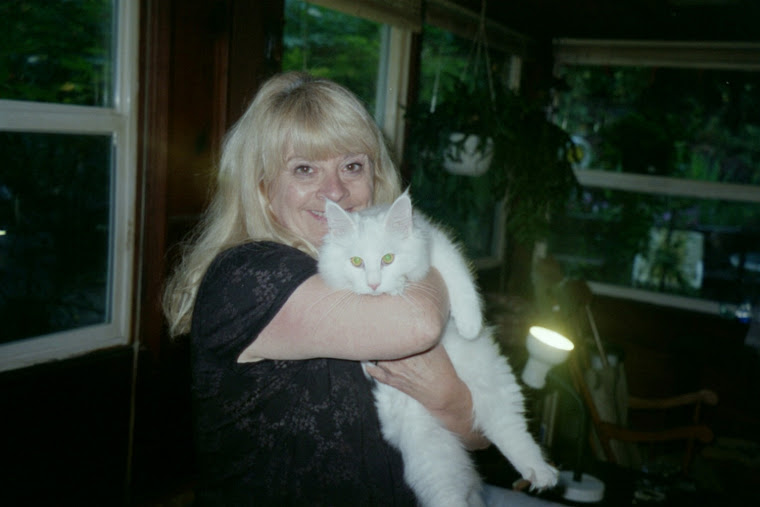
Advent Wreath and our special blessing- Tankene the Norwegian Forest kitten

Advent wreaths are easy to make and a great way to celebrate this spiritual season. Gather some evergreens or other native plants common in your area and shape them in a circle. Place the candles around the wreath, evenly distributed. There should be three purple and one rose. The first Sunday of Lent, light one of the purple candles.This is to symbolize prayer and penance and remind us to prepare for the coming of Christ. On the second Sunday, light another purple candle and reflect on the hope Christians find in Jesus. The third Sunday, light the rose candle and rejoice that our savoir's birth is near. I think of this as the candle symbolizing the joy we find in Christ. Another purple candle is lit on the last Sunday of Advent reminding us that Jesus is King. On Christmas Eve, a white candle is set in the center of the wreath to remind us that Jesus is the light of the world! Merry Christmas.
Our home is again filled with a special light with the new addition of Tankene Ice Mist- our new Norwegian Forest kitten. Mr.Chub already is his best friend and the Princess Sinatra is hissing less and less. More about him next post.
Wednesday, October 1, 2008
Oct. 4th

Oct. 4th is the Feast of St. Francis ....... all over the country pets are blessed in various kinds of churches on his Feast day.. Our kitten, Sly, was blessed yesterday by our priest during Mass .A moment of silence was observed to pray for Sly. Today Sly went to the Oncologist because we think he has cancer. So say a little blessing for Sly and all the other pets we love.

Tuesday, August 19, 2008
Sly The Kitten

My kitten, Sly, was sick and diagnosed with Lymphoma or FIP. We prayed, our friends and family prayed and after two weeks...his blood test came back normal. He's eating and playing his normal kitty games. Thanks be to Jesus. Please keep up the prayers because it is a miracle he's doing so well!
Subscribe to:
Posts (Atom)